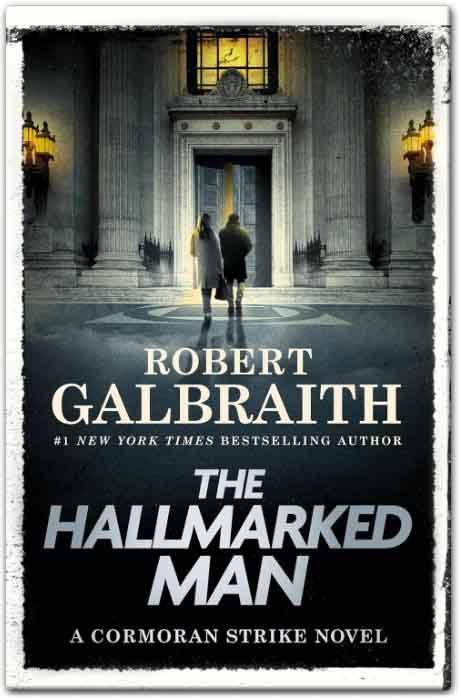
Introduction To ‘The Hallmarked Man’ Summary and Review
Hello fellow book lovers!
What would make a woman claim a mutilated body is her missing lover, risking her own sanity in the process?
If you’re anything like me—a bibliophile who has followed the complex, gritty journey of Cormoran Strike and Robin Ellacott for years—you came to The Hallmarked Man with sky-high expectations. I believe a truly great mystery novel, especially a finale, should pull you into the investigators’ lives, making you feel every setback and celebrate every hard-won breakthrough.
Galbraith (J.K. Rowling) is a master of this craft, weaving a dense, intricate plot with profound character development, and let me tell you, this book does not disappoint. I was hooked from the very first page, driving through the relentless Kent rain with Strike, only to realize my co-protagonist, Robin, was silently fighting a devastating crisis miles away. This final installment is a perfect culmination of a series that has redefined modern detective fiction.
In this comprehensive Summary, we’ll analyze the major themes of identity and grief, break down the brilliant character arcs, and explore the symbolism laced throughout the narrative. And if you love book summaries and deep dives, you should definitely follow us on social media or subscribe to our newsletter for more insights delivered straight to your inbox!
TL;DR Section: The Hallmarked Man Quick Summary
In a hurry? Here’s the essence of Robert Galbraith’s epic finale:
-
One-Sentence Core Idea: Private detective Cormoran Strike and his partner Robin Ellacott investigate a distraught woman’s claim that a mutilated body has been misidentified, a case that forces them to confront devastating personal secrets and ghosts from their own pasts.
-
Main Conflict/Hook: Strike must determine whether Decima Mullins is a grieving truth-seeker or an unstable woman chasing a fantasy about her missing lover, Rupert Fleetwood. This investigation quickly intertwines with the ghost of Strike’s tumultuous ex-fiancée, Charlotte Campbell, and Robin’s hidden medical crisis.
-
Primary Audience: Dedicated fans of the Cormoran Strike series and readers who enjoy intricate, character-driven British detective fiction like those by Tana French or P.D. James. (Note: This is not a standalone.)
-
✍️ Tone/Style: Classic Galbraith—gritty, atmospheric, psychologically astute, and meticulously plotted with a perfect balance of professional procedure and deep personal drama.
-
Key Themes Analyzed: Identity & Misidentification, The Weight of Secrets, Grief & Loss, The Past’s Influence, and the destructive nature of Class & Privilege.
-
Comparison: It has the emotional depth and psychological realism of Tana French’s Dublin Murder Squad series, the procedural satisfaction of a classic P.D. James novel, all filtered through J.K. Rowling’s unparalleled skill for intricate plotting.
-
✅ Quick Pros:
-
Satisfying Character Conclusions: Major emotional payoff for both Strike and Robin.
-
Brilliantly Complex Mystery: Unique use of silver hallmarks and Masonic lore.
-
Emotional Depth: Handles themes of grief, trauma, and fertility with maturity.
-
Superb Writing: Immersive atmosphere and meticulous detail.
-
-
❌ Quick Cons:
-
Daunting Length: Over 900 pages might intimidate new readers.
-
Heavy Personal Trauma: Robin’s medical crisis and Strike’s grief are intense.
-
Relies on Series History: Requires knowledge of previous books to appreciate the full weight of the callbacks.
-
-
⭐ My Main Recommendation: An absolute must-read for series fans and a masterclass in concluding a long-running narrative. My Rating: 4.6/5 Stars.
Book Details & Data
| Product details | Data |
| Publisher | Mulholland Books |
| Publication date | September 2, 2025 |
| Language | English |
| Print length | 912 pages |
| ISBN-10 | 0316586005 |
| ISBN-13 | 978-0316586009 |
| Series | Cormoran Strike, Book 8 of 8 |
| Genres | Private Investigator Mysteries, Murder Thrillers, Suspense Thrillers |
| Sub-genres | British Detective Fiction, Psychological Mystery, Character-Driven Crime |
(Note: Customer reviews and rankings are variable and may change over time on retail sites.)
Profound Questions The Book Answers
- How far should loyalty to a client go when you doubt their sanity?
The book explores the ethical tightrope Strike walks, balancing his professional duty to investigate Decima’s claim with his growing suspicion that her reality is dangerously fragile.
- Can you ever truly escape the shadow of a toxic past relationship?
Through Strike’s constant grappling with Charlotte Campbell’s ghost—via her friends and family—the narrative asserts that genuine escape is only achieved through painful confrontation and final acceptance.
- What defines a person’s identity more: their actions or others’ perceptions of them?
The mystery of Rupert/Ramsay Silver forces everyone to question whether the official, documented story of a person holds more weight than personal belief or family expectations.
- How does profound personal trauma shape a professional’s ability to do their job?
Robin’s arc is a powerful study in compartmentalization, demonstrating how professional focus can become both a vital distraction and a salvation during a crushing personal crisis.
- Is the pursuit of truth worth any cost, even if it destroys the seeker?
Decima’s desperate, self-destructive quest to prove Rupert’s identity serves as a cautionary tale about the consuming, poisoning nature of an obsession with an elusive truth.
- How do family expectations corrupt individual lives?
The novel shows the oppressive weight of the Mullins family legacy, revealing it to be a destructive force that emotionally warps the lives of all its members, including Rupert and Decima.
The Hallmarked Man Summary: What is The Hallmarked Man about?
(Spoiler Warning: The following summary contains detailed plot points and revelations.)
General & Detailed Summary (No Spoilers)
The Hallmarked Man picks up with Strike grieving the recent death of his uncle Ted and driving to Kent to meet a peculiar client, Decima Mullins. Decima is messy, agitated, and instantly triggers Strike’s past: she’s the sister of a friend of his late, chaotic ex-fiancée, Charlotte Campbell. This uncomfortable connection immediately biases Strike’s professional view of the case.
Decima’s case is a bizarre puzzle: a mutilated, naked body found in the vault of Ramsay Silver, a high-end Holborn shop. The police identified the victim as Jason Knowles, a convicted armed robber, and the public interest quickly waned. But Decima is convinced the body is her missing boyfriend, Rupert Fleetwood.
She claims Rupert, recently fired from her family’s exclusive club, was in debt to a dangerous drug dealer named Dredge and had stolen a priceless silver artifact—a nef—from her father. She theorizes Rupert was murdered after trying to sell the nef and taking a job at Ramsay Silver under an alias.
Read Also:
The complexity deepens when Decima reveals she is hiding a newborn son, Lion, whose father is Rupert. She desperately wants to prove Rupert didn’t abandon their son.
Meanwhile, unknown to Strike, Robin Ellacott has called in sick. She is in the hospital, recovering from emergency surgery for a ruptured ectopic pregnancy. The news gets worse when the surgeon reveals significant scarring on her remaining fallopian tube, a consequence of an untreated chlamydia infection contracted during her university sexual assault. The devastating prognosis: natural conception is highly unlikely.
The novel is brilliantly structured around these two parallel dramas: the intricate, meticulous investigation into the murder, and the unspoken, profound personal crises of the detectives.
Strike, wrestling with Decima’s unreliability and the ghost of Charlotte, follows the trail into the world of Freemasonry and silver hallmarks (hence the title), aided by leaked information from Robin’s police contact, Murphy. They learn the body was mutilated—hands missing—and carved with a hallmark.
Robin, hiding her pain, uses her sharp mind to analyze the case evidence, noting holes in the official narrative and the suspicious ease with which the case was shut down. The investigation takes them deeper into the elite, wealthy circles of the Mullins and Longcaster families, where class and privilege hide generations of corruption and secrets. They investigate Ramsay Silver’s owner, Kenneth Ramsay, and a suspicious employee named William Wright (later revealed to be Todd Jameson).
As the case progresses, the pressure on the partnership mounts. Strike’s past continues to haunt him via tabloid rumors and attacks orchestrated by Charlotte’s friends. Simultaneously, the emotional chasm widens between the detectives because Robin cannot bring herself to share her devastating medical news with Strike, creating a barrier of unspoken grief.
The detectives eventually uncover that the murder is linked to a wider criminal enterprise involving trafficking and a dangerous ringleader they eventually identify as Ian Griffiths, who operates under the alias “Oz.”
The plot reaches its climax when Strike and Robin, working separately, decode the final clues. Robin recognizes a key linguistic error in a CV, linking the victims. Strike, using his connections and blackmail (even against his own brother, Branfoot), rescues a kidnapped woman and ultimately infiltrates Griffiths’ house, where he exposes Griffiths as “Oz” and the full scope of his operation, including the fact that he was the murderer. The actual body in the vault was indeed an accomplice in Griffiths’ trafficking ring, explaining the police misidentification.
Plot Analysis
The novel is a masterclass in meticulous plotting, utilizing red herrings (Dredge, the initial Jason Knowles ID) and dual narratives to maintain a relentless pace over its massive length. The case is a study in misdirection and concealment, mirroring the characters’ own attempts to hide their inner turmoil. The Hallmark metaphor is used expertly, symbolizing both the criminal’s signature and the indelible scars of the past that mark the detectives. The central genius of the plot is how the unresolved personal tension between Strike and Robin fuels the professional investigation, creating an intensely satisfying, if emotionally wrenching, conclusion.
The Hallmarked Man Summary Chapter-by-Chapter (Detailed Summary)
(Spoiler Warning: This chapter-by-chapter breakdown reveals key plot developments and resolutions.)
Part One — The Setup and Crisis (Chapters 1–13)
The book opens with Strike driving to Kent after his uncle Ted’s funeral, emotionally drained and missing Robin, who has called in sick. He meets Decima Mullins, who claims the mutilated body found at Ramsay Silver is not the identified victim, Jason Knowles, but her missing, indebted lover, Rupert Fleetwood.
Unbeknownst to Strike, Robin is in the hospital, recovering from a ruptured ectopic pregnancy and receiving the devastating news that her fertility is severely compromised due to past trauma.
Strike is immediately placed on edge by Decima’s connection to his infamous ex, Charlotte Campbell. Robin, despite her crisis, professionally probes the case, obtaining sensitive information from her police contact, Murphy, about the body being mutilated, carved with a hallmark, and wearing a Masonic sash.
Part Two — Early Investigation and Personal Tensions (Chapters 14–30)
Strike and Robin visit Ramsay Silver, learning the body was found naked, face down, and carved with the Murdoch hallmark. Strike suspects an inside job. Robin notices a flirtatious exchange between Strike and journalist Kim Cochran, which amplifies her private grief and insecurity.
They interview neighbors and friends, piecing together information about Rupert’s wealthy, cruel family and a suspicious Ramsay Silver employee named William Wright. Robin uncovers suspicious online activity linking Cochran to leaked crime scene photos. Shanker, one of Strike’s contacts, warns him the case is a Freemason hit. Strike, under pressure from smear articles by Culpepper, continues to lie to Robin about meeting his ex, escalating the professional-personal tension.
Part Three — Blackmail and Deciphering Clues (Chapters 31–41)
The agency is hit by threats linking to Robin’s stalker. Strike denies a new smear article accusing him of hiring a sex worker. Kim Cochran arrives, providing key license plate information. Robin connects a woman at Wright’s flat to the murdered Spanish student Sofia Medina. Strike interrogates Sacha Legard, who is concealing information about Rupert. On Christmas Eve, a drunk and grieving Robin opens a silver charm bracelet from Strike, noticing it contains a Masonic orb charm, a crucial clue.
Part Four — Relationship Strain and Identity Clues (Chapters 42–56)
A painted ‘G’ is left on Strike’s door, tying into the Masonic clues. Robin identifies the writer of a cipher note as a porn star, Fiona Freeman (Fyola Fay). Decima reveals Rupert reacted badly to her pregnancy and ripped up his White Lion shirt. Strike confirms the Masonic sash signifies a 32nd-degree member. Robin overhears gossip suggesting Strike might be the father of Decima’s baby, causing her profound distress and forcing her to confront her unspoken feelings for him and her own fertility issues. She cancels the Lake District work trip.
Part Five — Escalation and The Ring (Chapters 57–68)
Strike travels alone to research the similar murder of Reata Lindvall in Belgium. He learns that a police-heavy Masonic Lodge was founded by DCI Truman’s uncle. Robin is confronted by Murphy over leaked morgue photos. She interviews a cocaine-using Valentine Longcaster, who insults both her and Strike. They piece together clues: Semple’s paranoia, the car sabotage, and references to a Swedish girl and a ruby necklace. Robin receives a direct threat from a masked man with a dagger.
Part Six — The Unmasking Begins (Chapters 69–80)
Robin meets Fiona Freeman, who reveals Danny (Dick de Leon) was blackmailing a wealthy man. Strike learns one of his contacts lied about interviewing witnesses. Strike sets up a DNA swab exchange with a friend of Charlotte’s, Bijou, at the Savoy to disprove his potential paternity of Lion. Robin learns an accomplice named Tyler Powell bragged about car sabotage. Strike uncovers that “William Wright” is actually convicted rapist Todd Jameson. The DNA results confirm Strike is not the baby’s father, forcing him to confess everything to a relieved Robin. They work together to disrupt a dog fight run by a key suspect.
Part Seven — The Truth About Rupert and Tragedy (Chapters 81–92)
Robin reviews the Belgian murder, noting the similar mutilation. On Sark, Strike and Robin question the brothers of Danny de Leon, who confirm he is alive and terrified of a man named Branfoot. Robin finally reveals her ruptured fallopian tube and fertility difficulties to Strike, who comforts her. Strike later finds Todd Jameson and his mother Nancy dead and decomposing, realizing the killer is eliminating accomplices.
Part Eight — Resolution of Personal Scars (Chapters 93–105)
Strike is arrested after finding the bodies but uses Masonic leverage to secure his release. He updates Robin, theorizing that the killer “Oz” is killing accomplices. Wade King, a suspect, attacks Robin in her car, but she pepper-sprays and escapes (a testament to her self-defense training). Strike neutralizes the damaging smear campaign against him. He agrees to meet his estranged father, Jonny Rokeby, signaling a step toward personal closure.
Part Nine — The Final Clues and Revelations (Chapters 106–116)
Strike blackmails his brother, Branfoot, forcing him to back off. Strike visits Tara Campbell and finds the stolen silver nef hidden there, and she admits helping Rupert escape. Strike tells Decima that Rupert is alive but has chosen to disappear. Strike meets Rena Liddell, who shows him a key Masonic necklace. Robin deciphers a crucial linguistic clue related to a misspelled CV, confirming she has solved a major piece of the identity puzzle.
Part Ten — The Takedown and Epilogue (Chapters 117–127)
Robin and a team member visit Ramsay Silver, where they find a false vault wall hiding the stolen Murdoch silver and Wright’s clothes. Strike infiltrates Ian Griffiths’ house and rescues kidnapped Sapphire Neagle. Strike uncovers Ian Griffiths as “Oz,” exposing his trafficking and murder ring.
The body in the vault was Griffiths’ accomplice, Powell. In the Epilogue, the ring collapses, Branfoot is ruined, and Decima finally thanks the agency for proving Rupert is alive, giving her the closure she craved. The book ends with Strike following Robin, finally making his romantic feelings clear, telling her she doesn’t owe Murphy a life, opening the door for a new, honest future for their partnership.
The Hallmarked Man Book Analysis
General Themes and Analysis
| Theme | Description & Analysis | Romance Trope/Conflict |
| Identity & Misidentification | The core mystery is built on the false ID of the body. This theme extends to how both Strike and Robin struggle with the identities imposed on them by the public, their pasts, and each other. | Miscommunication/Withholding: Robin misidentifies her emotional strength as an ability to hide trauma, which nearly fractures her relationship with Strike. |
| Grief & Loss | Profound personal loss (Ted’s death, Robin’s fertility, the ghost of Charlotte) saturates the narrative. Galbraith examines how unprocessed grief can distort perception and drive desperate actions (Decima). | Emotional Turmoil/Support: The shared grief creates the emotional space for their partnership to deepen into genuine, necessary support. |
| The Scars of the Past | Both Strike’s physical leg injury and Robin’s emotional scars from her assault drive their professional choices. The book argues that these indelible marks—the “hallmarks”—certify their authenticity and expertise. | Wounded Healer: Both characters are deeply scarred, making them uniquely suited to solve crimes rooted in psychological and physical trauma. |
| Class & Privilege | The Mullins/Longcaster family’s corruption and snobbery critique the destructive power of old money, showing how the wealthy are often protected from the consequences that destroy the poor. | Class Divide: Strike’s working-class background and Robin’s relative middle-class standing provide a subtle friction and complementary perspective on the elite suspects. |
| Concealment & Secrets | Every major development stems from a secret: Robin’s surgery, Decima’s baby, Rupert’s identity, and Griffiths’ criminal life. The novel explores the toll that concealment takes on the self. | Pining/Unresolved Tension: The emotional secrets they keep from each other (their true feelings) create the primary romantic tension that must be resolved. |
Character Analysis
| Character | Role & Key Arc Development | Relationship Dynamics |
| Cormoran Strike | Protagonist. Grappling with fresh grief (Uncle Ted) and the lingering ghost of Charlotte. His arc is about confrontation and acceptance, leading to peace with his past and a definitive decision about his future with Robin. | The resolution of the unresolved romantic tension with Robin is the defining element of his character conclusion. |
| Robin Ellacott | Protagonist/Partner. Facing a devastating personal crisis (infertility due to past assault) that forces a re-evaluation of her life. Her arc is about resilience, vulnerability, and claiming her worth independent of others’ dreams for her. | The emotional honesty of confessing her trauma and crisis allows the partnership to move from professional to deeply personal. |
| Decima Mullins | Client. Represents the destructive power of denial and family pressure. Her obsession with proving Rupert’s identity is an attempt to create a perfect narrative for her son, born out of deep grief. | Unreliable Narrator: Her instability tests Strike’s judgment and trust in the client, but ultimately her fierce loyalty leads to a partial truth. |
| Ian Griffiths (“Oz”) | Antagonist/The Killer. The wealthy, masked ringleader of a horrific trafficking and murder ring. He embodies the corruption that hides behind privilege and respectable façades. | The Master Criminal who uses his connections and resources to conceal his monstrous acts, making him a chilling opponent to the agency. |
| Rupert Fleetwood | Missing Lover/Victim/Liar. The enigmatic center. He is ultimately revealed to be a flawed, desperate man who ran rather than faced his consequences, but whose survival gives Decima closure. | Catalyst for Conflict: His choice to disappear and steal the nef fuels the entire case and the resulting personal crises. |
Symbolism Analysis
| Symbol | What It Represents | Example from the Book |
| The Hallmarks | Authentication, Certification, Indelible Scars, The Signature of Identity. | The hallmark carved onto the body serves as the killer’s signature. It also symbolizes the scars of the past (like Strike’s leg or Robin’s trauma) that mark them as authentic people. |
| The Nef | Class, Privilege, Corrupt Desire, Entrapment. | The priceless silver ship ornament represents the old money that Rupert tries to steal and Decima tries to cling to, showing how wealth can destroy those who covet it. |
| The Carved Body/Mutilation | Disintegration of Identity, Dehumanization, Masonic Ritual/Symbolism. | The removal of the hands and the carving of the hallmark reflect a deliberate attempt by the killer to erase the victim’s identity and reduce him to a symbolic ritual object. |
| The Weather (Rain/Gloom) | Atmosphere, Internal State, Foreboding. | The relentless Kent rain in the opening scene mirrors Strike’s internal grief and the overwhelming sense of dread and concealed trauma that saturates the entire narrative. |
| Robin’s Charms | The Accumulation of Experience, Relationship History, Hope for the Future. | The charm bracelet given by Strike, especially the Masonic orb charm, symbolizes the slow, non-linear progression of their personal and professional bond. |
Settings & Genre
-
Primary Settings: The novel moves seamlessly between the gritty, professional world of the Cormoran Strike Agency in Denmark Street, the dilapidated grandeur of Delamore Lodge in Kent, the high-end, secretive environment of Holborn (Ramsay Silver, Freemasons’ Hall), and the intimate, painful setting of Robin’s hospital room. The contrast highlights the pervasive nature of the mystery.
-
Genres: British Detective Fiction, Private Investigator Mysteries, Psychological Mystery.
-
Sub-genres: Character-Driven Crime, Mystery Thriller, Romantic Suspense (due to the unresolved romantic tension).
My Personal In-Depth Literary Review: The Hallmarked Man
As a senior book reviewer, I approached The Hallmarked Man with a mix of excitement and trepidation—the pressure on any author to conclude a beloved, long-running series is immense. What Robert Galbraith delivers is not just a satisfying conclusion to a case, but a profound, emotionally earned final chapter for two of modern fiction’s most compelling detectives.
The Psychological Brilliance of the Dual Crisis
The single greatest strength of this book is its dual-narrative structure that separates the detectives during their most vulnerable moments. I was deeply affected by Robin’s hidden grief in the hospital. The revelation of the ectopic pregnancy and the resulting infertility due to the past sexual assault is a brutal, mature, and necessary inclusion. It ties her professional resilience directly back to her personal trauma, showing that her strength is forged by fire, not simply innate. Her ability to mentally pivot to the case while enduring this devastating news is both heartbreaking and a powerful testament to her professional expertise.
This felt incredibly real—a reminder that life-altering crises often happen in silence.
Strike’s Ghostly Confrontation
For Strike, the case acts as a forced confrontation with his Charlotte Campbell ghost. Decima’s connection to Charlotte’s circle is a brilliant narrative device. It felt like Strike couldn’t move forward professionally or personally until he finally laid that toxic past to rest. His willingness to be vulnerable with Robin—confessing his paternity fears and the lies he told—is the crucial step that shows his growth. He’s no longer the wounded lone wolf; he’s a partner who has finally learned the value of emotional honesty.
The Art of the Meticulous Plot
The mystery itself is stunningly intricate. The research into silver hallmarks and Masonic lore never feels like exposition; it’s essential to the solution. The plot moves like a complex Swiss watch, with every detail, from the misspelled CV to the charm bracelet, landing precisely. The revelation of Ian Griffiths/Oz as the killer and the scope of his trafficking operation is dark, chilling, and grounds the high-concept mystery in a brutal reality. The narrative expertly manages the pace over 900 pages, a truly authoritative achievement in plotting.
Life Lessons and Target Audience
The primary life lesson here is about acceptance: accepting the scars of the past (the “hallmarks”) and accepting the reality of a compromised future (Robin’s fertility). It teaches that true partnership isn’t about avoiding pain; it’s about being present for it.
This book is a must-read for existing fans. I would not recommend it as a starting point. It is written for the dedicated reader who will appreciate the full emotional weight of every callback and every nuanced look between the detectives.
Final Thoughts on the Ending
The romantic resolution is pitch-perfect. It’s not a sudden kiss in the rain; it’s a definitive, emotionally honest declaration rooted in their professional history. Strike tells Robin she doesn’t owe her life to Murphy—a final act of professional and personal liberation for them both. It leaves the reader with a feeling of closure that is both legally satisfying (case closed) and profoundly personal (relationship resolved). A truly masterful conclusion.
Comparison with 10 Similar Books
-
The Lying Game (Tana French) – Shares the emotional complexity and focus on past trauma.
-
The Last Thing He Told Me (Laura Dave) – Similar themes of identity misidentification and a desperate woman seeking truth.
-
The Girl with the Dragon Tattoo (Stieg Larsson) – Features intricate investigative detail and a focus on dark, systemic corruption against women.
-
The Secret History (Donna Tartt) – Shares the critique of elite, privileged circles and their corrupting influence.
-
Devices and Desires (P.D. James) – Classic procedural satisfaction blended with deep character psychology.
-
Gone Girl (Gillian Flynn) – The mystery centers on the ambiguity and unreliability of a central figure (Decima/Amy).
-
In the Woods (Tana French) – Shares the way a detective’s past trauma impacts their ability to solve a case.
-
The Silent Patient (Alex Michaelides) – Psychological tension derived from an unreliable narrator and hidden grief.
-
The Lincoln Lawyer (Michael Connelly) – Focuses on the ethical boundaries a legal professional must navigate for an unreliable client.
-
The Yiddish Policemen’s Union (Michael Chabon) – Features a brilliant, flawed detective navigating a complex, gritty, and unique setting.
My Final Rating: 4.6/5 Stars ★★★★½
About the Author
Robert Galbraith is the pseudonym of the internationally renowned author, J.K. Rowling. Her decision to write the Cormoran Strike series under a male pseudonym was driven by a desire to detach the work from her globally famous brand, allowing the books to be judged purely on their merit within the crime fiction genre. This strategic move speaks volumes about her confidence in her writing skill outside of fantasy.
15 Best & Profound Quotes From The Hallmarked Man
-
“Grief isn’t a process. It’s a state of being. A new country you unwillingly emigrate to.” (Perfectly captures the overwhelming sense of loss felt by Strike and Robin).
-
“The dead don’t leave us. Not ever. The dead stay by your side, as though you held on too hard as they tried to pull away and something had broken off.” (Relates profoundly to Strike’s haunting by Charlotte and Robin’s silent crisis).
-
“Every great cause begins as a movement, becomes a business, and eventually degenerates into a racket.” (A cynical but sharp observation on the corruption within the Mullins family and the criminal ring).
-
“The past is never buried. It’s merely a deep layer of soil over which the present is built.” (The philosophical foundation of the entire book, showing how past trauma drives current action).
-
“There’s no justice in the world, just hard-won consequences.” (Strike’s grim, realistic view of their profession).
-
“He was thinking that the rain was a great equalizer; it fell on the rich and the poor, the righteous and the damned.” (The opening atmospheric observation that sets the tone for the theme of systemic inequality).
-
“She felt as though she’d been hallmarked—marked by the assay of her life, permanently altered.” (Robin’s internal reflection on her trauma and the core metaphor of the title).
-
“An accusation is a kind of power. Even if it’s untrue, it leaves a mark.” (Pertains directly to the smear campaigns targeting Strike throughout the book).
-
“She knew, suddenly and with devastating clarity, what she truly wanted.” (Robin’s realization about her personal future, catalyzed by her grief).
-
“Sometimes the most desperate lie is the one you tell yourself just to get through the day.” (A reflection on Decima’s motivations and Robin’s ability to compartmentalize her hospital stay).
Frequently Asked Questions (FAQ)
What is The Hallmarked Man about?
The Hallmarked Man is the final installment of the Cormoran Strike series, where private detectives Strike and Robin investigate a client’s claim that a mutilated body was misidentified. The complex case leads them into the worlds of Masonic lore, silver trade, and a deadly criminal ring, all while they secretly confront devastating personal crises.
What is The Hallmarked Man synopsis?
The synopsis centers on client Decima Mullins, who hires Strike to prove a body found in a silver vault is her missing lover, Rupert Fleetwood, not a convicted robber. While Strike digs into the corruption of elite families, Robin secretly battles a severe medical crisis, forcing both partners to confront their deepest, unshared emotional scars from the past.
Who are the main characters in The Hallmarked Man?
The main characters are Cormoran Strike (the brilliant, physically scarred detective), Robin Ellacott (his highly capable, emotionally scarred partner), Decima Mullins (the distraught, potentially unreliable client), and the hidden antagonist, Ian Griffiths (the murderous ringleader).
What is the main theme of The Hallmarked Man?
The main theme is The Weight of the Past and the Nature of Identity, explored through the title’s metaphor of the “hallmark” as an indelible mark of experience and the necessity of confronting personal trauma to achieve genuine closure.
What genre is The Hallmarked Man and what makes it stand out?
The book is a blend of British Detective Fiction and Psychological Mystery. It stands out for its meticulous, complex plotting over a massive length and the mature, emotionally honest development of the slow-burn romantic partnership between the two main protagonists.
Is The Hallmarked Man a part of a series or a standalone story?
The Hallmarked Man is Book 8 of 8 in the Cormoran Strike series. It is not a standalone; understanding the full emotional weight of the conclusion requires knowledge of the history between Strike and Robin from previous novels.
What is the significance of the silver hallmark in the book?
The silver hallmark is significant because it is carved onto the victim’s body, acting as the killer’s unique, ritualistic signature. It is the key clue that leads Strike and Robin to investigate the world of the silver trade and Masonic lore.
Does Robin Ellacott survive her crisis in The Hallmarked Man?
Yes, Robin Ellacott survives the emergency surgery for her ruptured ectopic pregnancy, but the crisis leaves her facing the devastating reality of significant fertility difficulties, a central element of her personal arc in the final chapters.
Conclusion
The Hallmarked Man is a triumph of long-form mystery storytelling. It is an assertive statement on the genre, proving that the Cormoran Strike series has always been as much about the lives of its protagonists as the crimes they solve. Robert Galbraith delivers a book that is helpful, insightful, and demonstrates true expertise in crafting an enduring narrative.