What if humanity’s first contact with an alien civilization didn’t bring hope, but extinction?
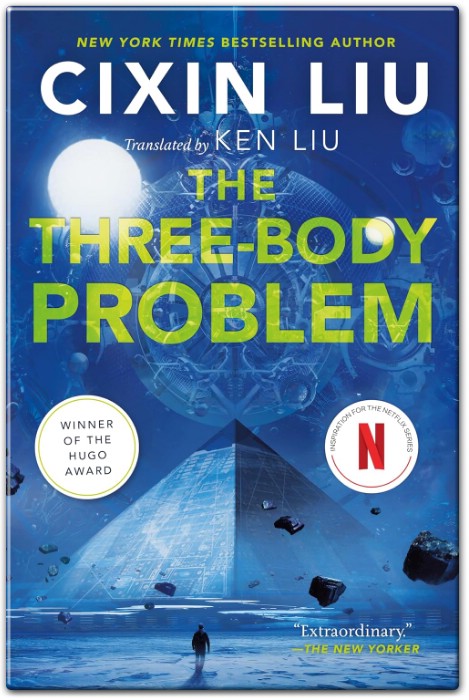
Cixin Liu’s The Three‑Body Problem tackles this frightening “what‑if” with intellectual rigor and emotional depth. The novel unfolds across decades, from the turmoil of China’s Cultural Revolution to the brink of a cosmic invasion. Centered on scholars Ye Wenjie and Wang Miao, the story blends hard science fiction with psychological suspense, exploring how scientific ambition, ideology, and hope can collide in a showdown of galactic proportions.
TL;DR Box – The Three‑Body Problem Summary
- Combines hard science fiction with philosophical questions about humanity.
- Ye Wenjie’s trauma during the Cultural Revolution leads her to contact the alien race Trisolaris.
- Sophons—alien technology—crystallize an existential crisis by halting scientific progress.
- The Earth‑Trisolaris Organization (ETO) splits into factions, debating humanity’s fate.
- Humanity’s resilience and survival instincts clash with cosmic forces beyond comprehension.
Five Key Questions Answered
- Why does Ye Wenjie invite Trisolaris to Earth, and what does it cost?
- How does the VR game “Three Body” foreshadow the invasion?
- What are sophons, and how do they cripple Earth’s science?
- What is the ETO’s role in altering humankind’s destiny?
- Will humanity survive? What does this mean for our future?
The Three‑Body Problem Summary & Review
Non‑Spoiler Overview
Crisis begins in the 1960s during China’s Cultural Revolution. Ye Wenjie, a brilliant astrophysicist, witnesses the brutal death of her physicist father. This traumatic exposure to violence fuels her disillusionment with humanity. She’s sent to the remote “Red Coast Base,” a military project that secretly focuses on interstellar communication. Believing humanity is beyond saving, Ye boldly contacts an alien civilization, the Trisolarans, hoping they’ll intervene.
Decades later, in the early 21st century, nanomaterials researcher Wang Miao investigates a wave of physicist suicides. He discovers a bizarre VR game—“Three Body”—which simulates a planet with chaotic orbits (the three‑body problem) and introduces players to the existential plight of the Trisolarans. As Wang dives deeper, Earth learns it’s under observational—and soon, direct—attack.
Chapter‑by‑Chapter Breakdown
- 1–3 (Cultural Revolution & Red Coast Introduction)
Ye Wenjie’s father is executed; she endures harsh labor and becomes seeded with resentment. At Red Coast, she uncovers its real mission: SETI with military oversight. She covertly sends an invitation to Trisolaris. - 4–7 (Wang Miao and the Scientific Crisis)
Strange events plague physicists worldwide. Wang enters the VR Three Body game, uncovering the Trisolaran context and existential risk. - 8–15 (Ye’s Confession and Expanded Mythos)
Ye recounts how she fully embraced alien contact. Wang and a police detective (“Da Shi”) confirm cosmic anomalies and alien interference. - 16–20 (Three Body Game and ETO Emergence)
Through successive game levels, players witness the rise of the Trisolaran fleet. In the real world, the Earth‑Trisolaris Organization forms under Ye and environmentalist Mike Evans. - 21–34 (Sophons, Factions, and Global Crisis)
Trisolaris deploys sophons—quantum protons—to Earth, sabotaging human research. ETO splits between “Adventists” (who want Earth destroyed) and “Redemptionists” (who want reform). Humanity struggles to respond. - 35 (Reflection at Red Coast Ruins)
Ye revisits the ruins, reflecting on her role in drawing Trisolaris to Earth and the irreversible consequences of first contact.
Main Characters
- Ye Wenjie – Disillusioned astrophysicist whose despair leads to Earth’s vulnerability.
- Wang Miao – Curious and determined scientist drawn into a reality‑bending mystery.
- Shi Qiang (“Da Shi”) – Pragmatic detective whose street‑smarts ground the narrative.
- Mike Evans – Charismatic leader of the ETO’s “Adventist” faction.
- Trisolaran Listener – Alien who warns humanity against response.
Themes & Analysis
1. Human Despair vs. Cosmic Alienation
Ye’s trauma drives her to seek radical change. Liu suggests that despair—when left unchecked—can risk inviting external salvation that may come at a terrible cost.
2. Science Under Siege
The introduction of sophons symbolizes the precariousness of human knowledge and the ethical ambiguity of scientific progress. What happens when knowledge itself is weaponized?
3. Ideological Extremes
The ETO’s rift—between those who want to save and those who want to destroy—mirrors eternal human divisions. It asks: Are some ideologies so dangerous they justify cosmic collateral damage?
4. Resilience of Humanity
Despite being labeled “bugs,” humans’ capacity to adapt and fight is central. Liu builds tension by contrasting cosmic apathy with human stubbornness.
Why The Three‑Body Problem Summary Matters
- For sci‑fi fans: Offers rigorous physics twisted with philosophical dread.
- For political‑history buffs: Weaves modern Chinese history with speculative narrative.
- For casual readers: Presents edge‑of‑the‑seat suspense alongside existential puzzles.
Final Verdict & Rating
The Three‑Body Problem is a cerebral, haunting journey that combines cosmic dread with emotional intimacy. Liu doesn’t just imagine first contact; he forces readers to ask what humanity is willing to sacrifice for its own survival. While the science‑fueled explanations can feel dense, they ground the novel in plausible realism. The success lies in its refusal to simplify: this is not space opera—it’s a philosophical mirror held up to the human race.
Rating: ★★★★½ (4.5/5)
- Strengths: Intricate plotting, compelling world‑building, philosophical heft.
- Weaknesses: Can be dry during technical exposition; some chapters slow the pace.
Ideal Audience for This Summary
- Sci‑fi readers who appreciate physics‑rich narratives.
- Academic reviewers or book clubs discussing existential themes.
- General readers seeking intellectual suspense and moral complexity.
Conclusion – The Three‑Body Problem Summary
In The Three‑Body Problem summary, Cixin Liu delivers a profound exploration of despair, hope, and the high cost of reaching for the stars. This book is an invitation—and a warning—to anyone who dreams of first contact. With elegant storytelling, layered characters, and scientific authenticity, this work establishes Liu as a titan of modern speculative fiction.
For those intrigued by philosophical conundrums wrapped in scientific mystery, The Three‑Body Problem isn’t just a read—it’s an experience. Weaving history, science, ideology, and human frailty into a cohesive whole, Liu crafts a cautionary tale about the vast unknown—and the poignant fragility of Earth.