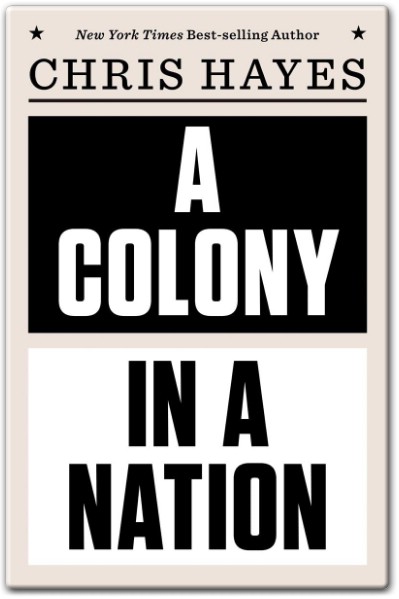
A Colony in a Nation Summary by Chris Hayes is a compelling and urgent examination of racial injustice, policing, and the stark inequalities embedded within the American justice system. In this insightful book, Hayes explores the troubling duality of the United States—a nation where rights and liberties coexist with a “colony” subjected to systemic oppression and aggressive law enforcement. Inspired by Richard Nixon’s infamous “law and order” rhetoric, Hayes presents a powerful thesis: America operates simultaneously as a nation upholding justice and a colony where marginalized communities, especially Black Americans, endure colonial-style policing and control.
The Core Thesis: Two Americas Within One Country
At the heart of A Colony in a Nation is the provocative idea that the U.S. functions as two overlapping realities. Hayes argues that one America—primarily white and middle class—experiences the justice system as a protector of rights. The other, largely Black and impoverished communities, lives under a system that acts like a colonial regime, where police enforce control through fear and force rather than protection. This “colony” is marked by aggressive policing, racial profiling, and the denial of fundamental rights.
Hayes vividly illustrates this divide by drawing historical parallels between colonial governance and modern-day policing. He references the protests in Ferguson, Missouri, as a pivotal moment exposing this systemic fracture. Here, police tactics mirrored those of occupying forces rather than community protectors, fueling distrust and anger.
Exploring the Roots of “Law and Order” Politics
In A Colony in a Nation Summary, Hayes traces the origins of “law and order” rhetoric back to Nixon’s political strategy, which exploited white fear of social change and racial progress. This phrase, Hayes contends, masked policies aimed at controlling Black populations under the guise of crime prevention. The book meticulously details how this political tactic contributed to mass incarceration and harsher criminal justice policies disproportionately impacting communities of color.
Hayes’ analysis extends beyond history to psychological and social dimensions, exploring how white fear—rooted in both social conditioning and individual neural responses—has driven punitive policies. The media’s sensationalized crime narratives exacerbate this fear, reinforcing stereotypes and justifying aggressive policing tactics.
The Criminalization of Poverty and Minor Infractions
One of the key insights in A Colony in a Nation is the criminal justice system’s focus on maintaining order over justice. Hayes critiques policies like stop-and-frisk, zero-tolerance, and harsh sentencing laws, which disproportionately target minor infractions in marginalized communities. He compares these policies to colonial “writs of assistance,” instruments of control designed to keep the “colony” subdued.
By framing poverty and disorder as criminal problems, the system traps countless individuals in cycles of incarceration, disrupting families and communities. Hayes highlights how this approach prioritizes control and punishment rather than rehabilitation and social support.
The Illusion of Fairness in the Justice System
Hayes does not shy away from exposing racial biases embedded deep within the judicial process. A Colony in a Nation Summary emphasizes that Black defendants frequently face harsher sentences than white defendants for similar offenses. This disparity extends to prosecutorial decisions and judicial rulings, often influenced by political pressures and financial incentives.
Through compelling data and case studies, Hayes dismantles the myth that the American justice system is inherently fair or impartial. Instead, he portrays it as a system designed to perpetuate inequality under the veneer of legality.
The War on Drugs: A Case Study in Racial Control
A critical section of the book examines the War on Drugs as a pivotal moment in America’s colonial policing. Hayes traces this campaign’s origins to Nixon’s presidency and its expansion under Reagan, demonstrating how drug laws became tools for mass incarceration, especially targeting Black communities.
Hayes argues convincingly that the War on Drugs was less about public safety and more about social control. This policy entrenched racial disparities, devastated communities, and fueled the prison-industrial complex.
Toward Justice: Reimagining Policing and Reform
In its concluding chapter, A Colony in a Nation offers hope through practical recommendations to dismantle the colonial mindset within law enforcement. Hayes advocates for systemic reforms including decriminalization of minor offenses, community policing that builds trust, and robust social programs addressing underlying economic and racial inequalities.
He calls on readers to confront their own biases and become active participants in the push for justice and equity. Hayes envisions a future where the “colony” can reclaim its rights, and the nation finally lives up to its ideals.
About Chris Hayes: A Unique Perspective
Chris Hayes brings a nuanced, deeply empathetic perspective to this topic. As a white journalist with a platform on MSNBC’s All In with Chris Hayes, he has long engaged with issues of race and justice from a place of humility and awareness of his own privilege. His immersive reporting in Ferguson and Baltimore enriches the book’s narrative, blending personal experience with rigorous research.
Key Takeaways from A Colony in a Nation Summary
- America operates as two distinct realities: a “nation” protecting rights and a “colony” subjected to aggressive policing.
- Nixon’s “law and order” politics laid the foundation for systemic racial control.
- White fear, amplified by media and politics, drives punitive criminal justice policies.
- The justice system criminalizes poverty and disproportionately punishes Black communities.
- Racial bias is embedded in policing, prosecution, and sentencing.
- The War on Drugs was a policy of social control, not public safety.
- Meaningful reform requires systemic change and community empowerment.
Why Read A Colony in a Nation?
This book is essential reading for anyone seeking to understand the roots of America’s racial justice crisis. It offers a critical lens on policing, criminal justice, and the persistent inequalities shaping daily life for millions. Chris Hayes’ clear, accessible writing combined with his journalistic rigor makes complex issues tangible and urgent.
Final Thoughts on A Colony in a Nation Summary
A Colony in a Nation challenges readers to rethink America’s justice system and confront uncomfortable truths about race, power, and control. It is both a scholarly analysis and a passionate call for change—an indispensable resource for activists, policymakers, educators, and concerned citizens alike.
By spotlighting the stark divide between the “nation” and the “colony,” Hayes provides a new framework for understanding America’s racial struggles and points toward a future where justice can be truly equitable.
If you want to dive deeper into the intersections of race, justice, and policing in America, A Colony in a Nation is a must-read. This summary aims to provide you with key insights and inspire further exploration of these urgent topics.