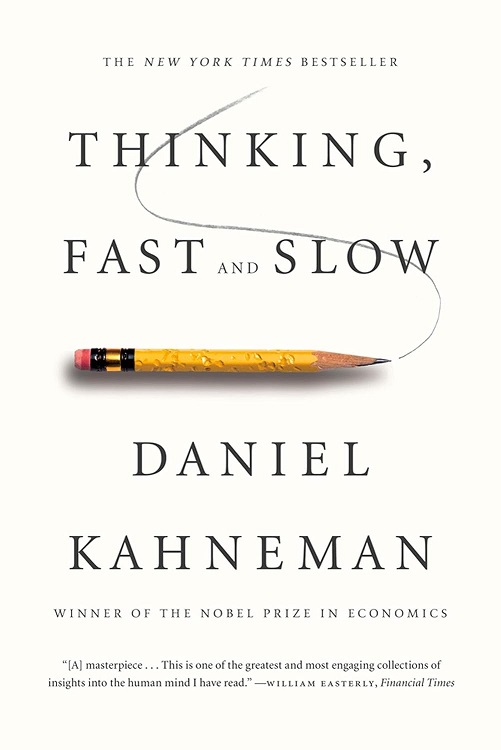
Thinking, Fast and Slow by Nobel Prize-winning psychologist Daniel Kahneman is a compelling exploration into how we think, why we make the decisions we do, and the mental shortcuts—often invisible—that influence our behavior. This bestselling book, which merges decades of psychological research with accessible writing, unveils the dual-system model of the mind and how cognitive biases subtly shape everything from personal choices to public policy.
In this detailed Thinking, Fast and Slow summary, we’ll walk you through the book’s key ideas, chapter highlights, and critical takeaways
Understanding the Two Systems of Thought
At the heart of Kahneman’s thesis are two systems of thinking:
- System 1 is fast, instinctive, and emotional. It operates automatically, without effort or conscious control.
- System 2 is slow, deliberate, and logical. It requires attention and is used when we engage in complex reasoning or problem-solving.
Kahneman reveals that while both systems are essential, much of our daily decision-making is guided by System 1—often leading to irrational conclusions, fueled by mental shortcuts known as heuristics and cognitive biases.
Chapter-by-Chapter Breakdown of Thinking, Fast and Slow
Chapter 1: The Two Systems
The opening chapter introduces the dual-system framework. Kahneman explains how System 1 helps us navigate everyday situations efficiently, but also how its reliance on intuition and pattern recognition makes it prone to errors. System 2, while more reliable, is energy-intensive and often “lazy,” allowing System 1 to take over more than it should.
Chapter 2: The Illusion of Transparency
We tend to believe we understand our own minds—and those of others—far better than we actually do. Kahneman describes the illusion of transparency, where individuals assume their thoughts and feelings are more obvious than they really are. This misperception can lead to communication breakdowns and misunderstandings, especially in social or emotional contexts.
Chapter 3: Noise
Randomness plays a much larger role in our lives than we’d like to admit. In this chapter, Kahneman introduces the concept of noise—the variability in judgments that arises from irrelevant factors. Two professionals given the same data can make vastly different decisions due to unconscious influences, proving that human judgment is often inconsistent and error-prone.
Chapter 4: The Halo Effect
The halo effect is the cognitive bias where we let one positive trait (like attractiveness or charisma) influence our entire impression of someone. Kahneman shows how System 1 jumps to conclusions based on limited information, reinforcing stereotypes and affecting decisions in hiring, branding, and even politics.
Chapter 5: Loss Aversion
Perhaps one of Kahneman’s most famous contributions is his work on loss aversion—the tendency to feel the pain of loss more intensely than the joy of an equivalent gain. This bias affects everything from investment behavior to everyday choices. People are more motivated to avoid losing $10 than to gain it, which explains many of our risk-averse behaviors.
Chapter 6: The Planning Fallacy
This chapter introduces the planning fallacy—our chronic underestimation of how long tasks will take and how difficult they’ll be. Whether it’s personal projects or corporate strategies, we often make plans based on best-case scenarios. Kahneman suggests using reference class forecasting—looking at similar past projects—to get more realistic timelines and expectations.
Chapter 7: The Endowment Effect
We tend to overvalue things simply because we own them. This is known as the endowment effect. Kahneman shows how ownership skews our perception of value, which has major implications in fields like marketing, real estate, and negotiation. It’s the reason why selling a personal item feels harder—and requires a higher price—than buying the same item.
Key Psychological Concepts in Thinking, Fast and Slow Summary
Here are a few core ideas that run throughout the book:
- Cognitive biases are mental shortcuts that can lead to irrational outcomes. From overconfidence to anchoring, these biases shape everything from consumer behavior to courtroom decisions.
- Heuristics are helpful but flawed tools the brain uses to make quick judgments. While useful in many situations, they often substitute an easy question for a harder one—leading to poor decisions.
- System 1 often answers the wrong question. If a difficult question is posed (e.g., “Is this stock a good investment?”), System 1 might answer a simpler version (“Do I like this company?”) without us noticing.
Why Kahneman’s Work Matters
Daniel Kahneman’s research, much of which he conducted with fellow psychologist Amos Tversky, earned him the Nobel Prize in Economic Sciences—not for work in economics per se, but for how his psychological insights revolutionized our understanding of human behavior in financial decision-making, public policy, and health care.
Kahneman makes a powerful case for being more aware of our thought processes, encouraging readers to recognize when their minds might be steering them in the wrong direction. The book is as much a guide to self-awareness as it is a treatise on psychology.
Who Should Read Thinking, Fast and Slow?
- Business leaders and entrepreneurs seeking to make more rational decisions and understand customer behavior.
- Students and professionals in psychology, economics, or behavioral science.
- Anyone curious about why they think the way they do and looking to reduce bias in everyday choices.
The book is dense in research, but Kahneman’s clear writing and practical examples make even the most complex concepts accessible. While it requires focus, the payoff is well worth the effort.
Practical Applications
- Better decision-making: By learning to recognize when you’re relying on instinct (System 1) versus logic (System 2), you can avoid common traps like overconfidence or misjudging risk.
- Improved communication: Understanding cognitive biases helps you frame messages more effectively, both in personal and professional contexts.
- Financial literacy: Awareness of biases like loss aversion and the endowment effect can lead to smarter investing and spending habits.
Final Thoughts: Thinking, Fast and Slow Summary
In this Thinking, Fast and Slow summary, we’ve explored how Kahneman’s work shines a light on the hidden forces that shape our thinking. His distinction between fast, intuitive thought and slow, rational analysis serves as a foundation for understanding human behavior in a variety of contexts.
The book is a masterclass in cognitive psychology and behavioral economics, teaching readers not just how to think better, but how to be more mindful of how they think in the first place.
If you’re looking to become a more reflective, deliberate thinker—whether in business, relationships, or life—Thinking, Fast and Slow is an essential read.