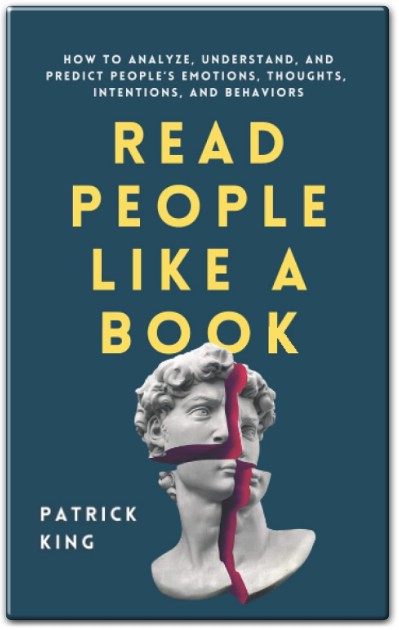
In today’s fast-paced, hyper-social world, the ability to understand others is one of the most valuable skills you can develop. Whether you’re building relationships, advancing in your career, or simply trying to decode what someone’s really thinking, social intelligence is your secret weapon.
In this Read People Like a Book Book Summary, we’ll explore Patrick King’s practical guide to reading human behavior with precision and confidence.
Patrick King—bestselling author and social dynamics expert—offers a deeply researched, psychology-backed toolkit that teaches readers how to interpret body language, facial expressions, tone of voice, and speech patterns. The result? A guide that transforms the way you interact with others—whether you’re in a job interview, negotiation, relationship, or casual conversation.
What Is Read People Like a Book About?
At its core, Read People Like a Book is about understanding what people think and feel—often without them saying a word. King’s approach blends scientific research, practical application, and real-world examples to help readers decode hidden signals and emotional cues. The book is less about manipulation and more about connection—allowing you to listen better, observe deeper, and react smarter.
This Read People Like a Book Book Summary breaks down the major insights chapter by chapter, showing how King teaches readers to become modern-day “social detectives” by mastering human psychology.
Chapter 1: Reading Body Language Like a Pro
The first lesson is all about body language—the unspoken dialogue that makes up 60-70% of all communication. According to King, body language is often more honest than words. People may lie with their lips, but their bodies often betray the truth.
Key Body Language Insights:
- Posture: Upright posture reflects confidence; slouching may signal insecurity or lack of interest.
- Gestures: Fidgeting can indicate anxiety or boredom, while open gestures suggest honesty and openness.
- Facial Expressions: Micro-expressions, such as a twitch of the lip or furrowed brow, can reveal real-time emotions.
- Eye Contact: Intense eye contact may signal interest or dominance, while lack of it can indicate discomfort or avoidance.
King stresses the importance of reading body language in clusters—not in isolation—and always considering the context. This chapter alone makes the book an essential read for anyone seeking to sharpen their interpersonal awareness.
Chapter 2: Face Reading – Decoding Personality & Emotions
Facial features carry more meaning than many realize. King dives into the science of face reading, analyzing how elements such as eyebrow thickness, mouth width, and facial symmetry can hint at personality traits.
Personality Clues From the Face:
- Wide mouth: Indicates sociability and expressiveness.
- Thick eyebrows: Often associated with confidence and leadership.
- Round face: Suggests warmth and approachability.
- Large eyes: Signal curiosity and emotional depth.
But King cautions: face reading is not an exact science. Instead, it should be used in combination with other cues—like body language and speech patterns—for a more accurate understanding of others.
Chapter 3: Voice Tone – Hearing Emotions Beneath the Words
Ever noticed how someone says more with their tone than their words? In this chapter, King breaks down how pitch, pace, rhythm, and volume reveal hidden emotions.
Emotional Clues in Tone:
- High pitch: Can indicate nervousness or excitement.
- Low tone: May reflect sadness, confidence, or seriousness.
- Shaky voice: Often signals emotional instability or fear.
- Rapid speech: Could be a sign of anxiety or urgency.
By learning to detect emotional tones, readers can better gauge sincerity, interest, hesitation, or hidden motives—especially in high-stakes conversations like sales, job interviews, or arguments.
Chapter 4: Speech Patterns – Understanding Thought and Motivation
The words people use are a direct line to their inner world. King teaches readers how to analyze speech to determine how someone thinks, feels, and what they want.
Categories of Speech:
- Thinking Words: Analytical, rational phrases like “I believe,” or “It makes sense.”
- Feeling Words: Emotional language like “I feel,” or “I’m heartbroken.”
- Action Words: Practical and task-focused, such as “Let’s do it,” or “I will.”
- Motivational Words: Goal-oriented phrases like “My dream is,” or “I want to succeed.”
King emphasizes listening not just to what’s said—but how it’s said. Repeated words, emotional tone, and body language all help decode the speaker’s mindset.
Chapter 5: The Complete Framework for Reading People
This final chapter unites everything. King outlines a systematic method to evaluate people holistically—factoring in emotional cues, psychological patterns, body language, and tone.
Holistic Reading Strategy:
- Emotions: Identify subtle and overt emotional cues.
- Thoughts: Analyze verbal structure and reasoning patterns.
- Motivations: Look for what drives their decisions—security, ambition, love, or fear.
- Intentions: Determine sincerity or manipulation based on mixed signals.
- Personality Types: Apply the DISC framework (Dominant, Inspiring, Stable, Conscientious) to interpret behavior.
King’s framework is especially useful for professionals in leadership, HR, education, and sales—where reading people correctly can make or break results.
Key Takeaways from Read People Like a Book
- Observation is power: People reveal more through behavior than through words.
- Emotional intelligence is a super-skill: Learning to read feelings sharpens both personal and professional relationships.
- Context is everything: No single gesture or phrase should be judged in isolation.
- Self-awareness enhances accuracy: The more emotionally intelligent you are, the better you’ll read others.
This Read People Like a Book Book Summary is more than a list of techniques—it’s a mindset shift. King shows that by slowing down, paying attention, and tuning in to the right signals, you can become someone who communicates with clarity, empathy, and impact.
Final Thoughts: Why You Should Read Patrick King’s Guide
Read People Like a Book is a practical and powerful resource for anyone looking to improve their communication skills, build stronger relationships, and decode the unspoken world around them. King’s advice is clear, actionable, and grounded in psychological science, making it an ideal read for business professionals, students, therapists, coaches, and anyone interested in human behavior.
Whether you’re navigating a high-stakes boardroom, a first date, or a difficult conversation with a loved one, this book gives you the tools to read between the lines—literally and figuratively.
About the Author: Patrick King
Patrick King is a renowned communication coach and author with expertise in human behavior, interpersonal dynamics, and emotional intelligence. With a background in psychology and years of hands-on experience, King’s books are widely praised for their clarity, relatability, and real-world application.